When people think about climate action, the conversation often focuses on the race to renewable energy. While this is absolutely a non-negotiable in the movement to address climate action, it only represents one side of the solution.
According to the Ellen MacArthur Foundation, 45 per cent of global greenhouse gas emissions come from the way we make, use and manage materials, products and food. These emissions sit within supply chains, manufacturing systems, construction processes, agriculture and waste generation, areas that cannot be fully addressed through renewable energy alone. That is where circular economy strategies come in.
The Thrive to 45: Tackling the forgotten 45 per cent of global emissions with circular strategies report, developed by Planet Ark and KPMG, explores how circular approaches can help reduce emissions in two major sectors: the built environment and fast-moving consumer goods (FMCG).
The report draws on desktop research, industry surveys and stakeholder roundtables to better understand how businesses are already adopting circular strategies, where the biggest opportunities lie and what barriers still need to be overcome.
Understanding the R strategies
As previous Planet Ark research has revealed, for many people the circular economy is still closely associated with recycling. Recycling remains important, but it is only one piece of a much bigger picture.
A circular economy aims to design out waste and pollution, keep products and materials circulating at their highest value for as long as possible and regenerate natural systems. One of the most practical ways to understand this is through the “R strategies” framework, sometimes referred to as the ladder of circularity.
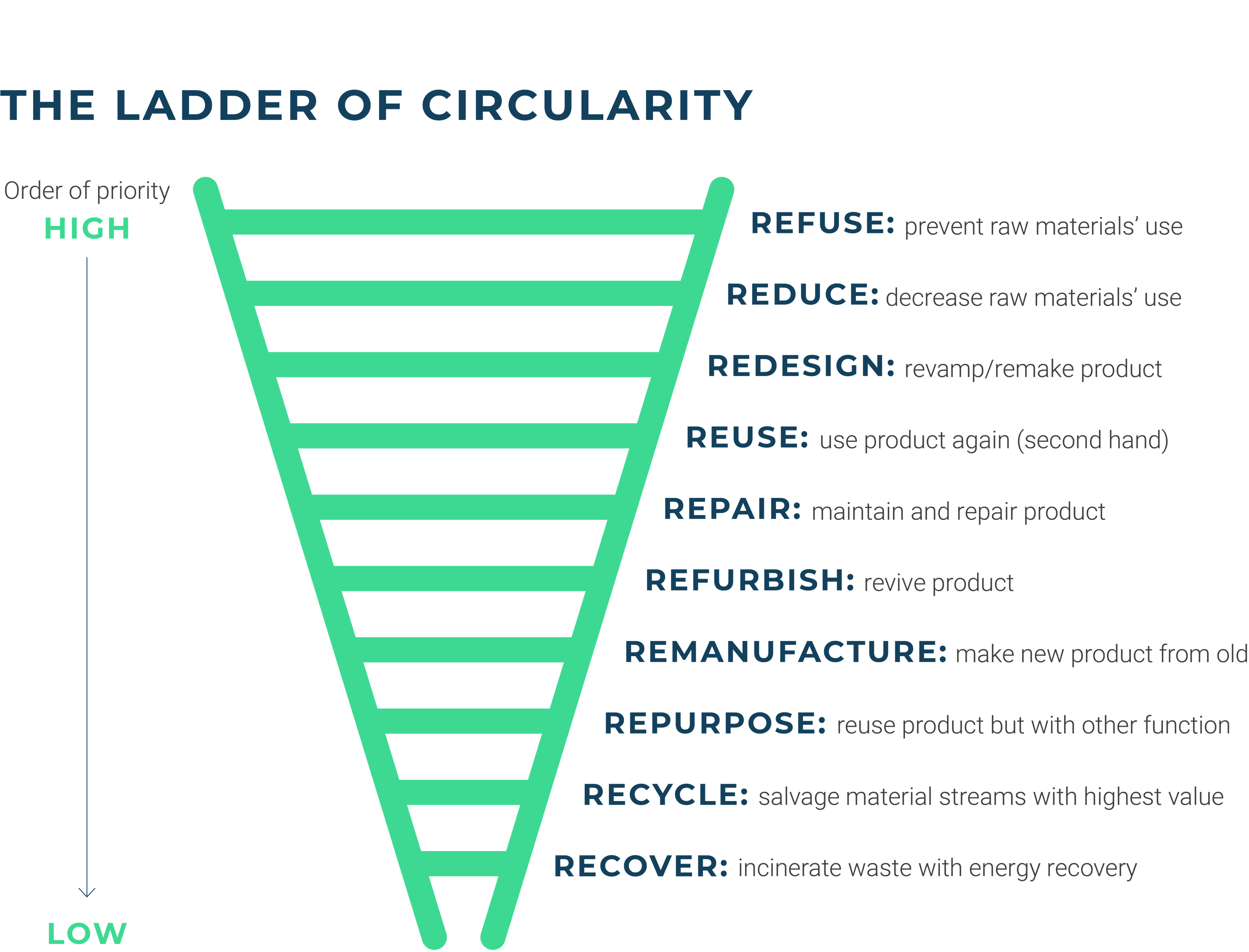
The ladder of circularity, also known as the R-ladder, is a hierarchical framework for the circular economy that ranks various 'R-strategies' based on their environmental efficiency. Image: Planet Ark
These strategies range from higher-order actions such as refuse, reduce, rethink, redesign and reuse, through to repair, refurbish, remanufacture, repurpose and recycle.
The report used these R strategies as a lens for analysing circular economy action across both sectors, helping identify which approaches businesses are already implementing and which are perceived to have the strongest potential to reduce emissions.
Importantly, the research found that higher-order strategies often deliver the greatest emissions reduction benefits because they reduce demand for virgin materials and retain more embodied carbon within existing products and systems.
What businesses are already doing
Encouragingly, 62 per cent of organisations surveyed reported they had already considered adopting circular strategies to reduce emissions.
Within the built environment sector, participants identified rethink, redesign, reuse and repurpose strategies as having the strongest potential for emissions reduction. This reflects growing awareness of embodied carbon and the significant emissions associated with extracting, manufacturing and transporting construction materials.
In the FMCG sector, redesign, recycle, reuse and reduce strategies were identified as having the strongest emissions reduction potential, particularly when applied to packaging, raw materials and supply chain management.
Participants across both sectors also highlighted opportunities to reduce emissions through improving material efficiency, reducing waste generation, engaging suppliers and supply chains, using alternative low-carbon materials, incorporating recycled content and shifting towards regenerative sourcing practices.
Circularity in action
The report showcases several case studies demonstrating how circular strategies can achieve measurable emissions reductions in practice.
One example highlighted in the built environment section is Quay Quarter Tower in Sydney. Rather than demolishing the original structure and rebuilding from scratch, the project retained 66 per cent of the existing building structure and 95 per cent of the original core.
This reuse-focused approach reduced embodied carbon emissions by approximately 12,000 tonnes of CO2e, while also reducing construction costs and shortening the construction timeline.
The report also highlights examples from the FMCG sector, including reusable beauty packaging systems, lightweight packaging redesigns and trials using higher recycled-content materials.
These examples reinforce that circular economy strategies are not theoretical concepts, but tangible actions already being applied across industries with tangible environmental and business benefits, even where the businesses implementing them don’t realise they are necessarily ‘circular economy’ actions.
Challenges remain
While momentum is building, the report also identified several barriers preventing circular strategies from becoming mainstream.
Participants pointed to fragmented regulation and inconsistent policy settings, limited access to reliable emissions and supply chain data, higher upfront costs and perceived risk, lack of infrastructure and recovery systems, limited awareness of circular strategies beyond recycling and challenges engaging consumers on more sustainable behaviours.
At the same time, many participants stressed the importance of not allowing the pursuit of perfection to delay action.
The report highlights the need for stronger collaboration across supply chains, clearer government policy signals, better education and improved access to practical tools that support decision making.
Circular economy as a climate solution
The findings from Thrive to 45 reinforce that achieving net zero will require more than just decarbonising energy systems. It will also require transforming how materials and products are designed, sourced, used and recovered across all sectors of the economy.
Circular economy strategies provide businesses with an opportunity to address emissions that sit beyond direct operations, particularly scope 3 emissions embedded within supply chains. They also offer broader benefits including improved resource efficiency, reduced waste, innovation opportunities and increased resilience in a resource-constrained future.
As organisations continue navigating climate targets, mandatory reporting requirements and evolving stakeholder expectations, circular economy action is likely to become an increasingly important part of the pathway forward.
Read the Thrive to 45: Tackling the forgotten 45 per cent of global emissions report in full.